 ← Washington eviction profile
← Washington eviction profile
← Washington eviction profile
Washington State · A white paper from the Eviction Research Network
Rents have outrun incomes, and the pandemic-era programs that held filings down have ended. Rather than receding, filings have settled about 44% above pre-pandemic levels. Federal supports for housing stability are now being withdrawn as well, and Washington's own 2023 data show what withdrawal does to the filing count. This paper traces what drives the increase, what the evidence says reduces it, and where the gaps in that evidence sit.
An exploratory analysis of county-level patterns and a review of the eviction-prevention literature. It describes correlations and policy context, not proven causes.
In brief · for Washington's lawmakers
Eviction filings register housing distress earlier than shelter lists or street counts. Washington's filings set a record in March 2026, and the supports that reduce them are being withdrawn.Source: Washington superior court unlawful-detainer records, January 2016 – April 2026, with Minnesota court records and a 29-state national extract for comparison.
Five things every Washington lawmaker should know:
The elevated level is sustained, not a spike, and a sustained level is the harder problem.
March 2026's 2,406 filings exceeded the prior record by 3.5%. Adjusted for seasonal swings, the month ranks 11th among the series' largest deviations, because the largest deviations all came in fall 2023, when filings stepped up sharply and never came back down. They settled about 44% above pre-pandemic levels and have held there since. A spike recedes on its own; a sustained level does not, and the series shows no movement back toward the old one.
Rent outran incomes.
Metro Seattle asking rents are up roughly 43% since 2017, about double the rise in metro Minneapolis. Across US counties, the share of renters paying 50%+ of income on rent is one of the two most reliable markers of where filing rates are high.
Filings surged in the months after two pandemic-era programs ended.
Federal rental aid and Washington's mandatory pre-filing mediation (the Eviction Resolution Pilot Program) held recorded filings low through mid-2023. When the pilot sunset on July 1, 2023 and aid ran out, filings surged that fall, producing the four largest seasonal deviations in the series. Part of the increase since then is the return of cases those programs had been diverting from court.
Washington has adopted the best-documented tools, but not at full scale.
The prevention measures with the largest documented effects are direct rental assistance, right to counsel, and pre-filing mediation. Washington has used all three: it was the first state to guarantee low-income tenants a lawyer (2021), and it capped annual rent increases statewide in 2025. But its right-to-counsel program reaches fewer than half of tenants facing eviction, its mediation pilot expired in 2023, and the federal assistance has ended.
The biggest unknown is local effect size.
Most published numbers for these levers come from other cities. The single highest-value next study is a Washington-specific measurement of how much rental assistance reduced filings here. The records to build it already exist; the estimate does not.
The bottom line: the problem is severe but tractable. The prevention levers with the strongest evidence are already in Washington law or have been run here before. The open questions are scale and timing, and both sit with the state: whether the tools are funded at the size of the problem before the remaining federal supports are withdrawn.
1 · The trend
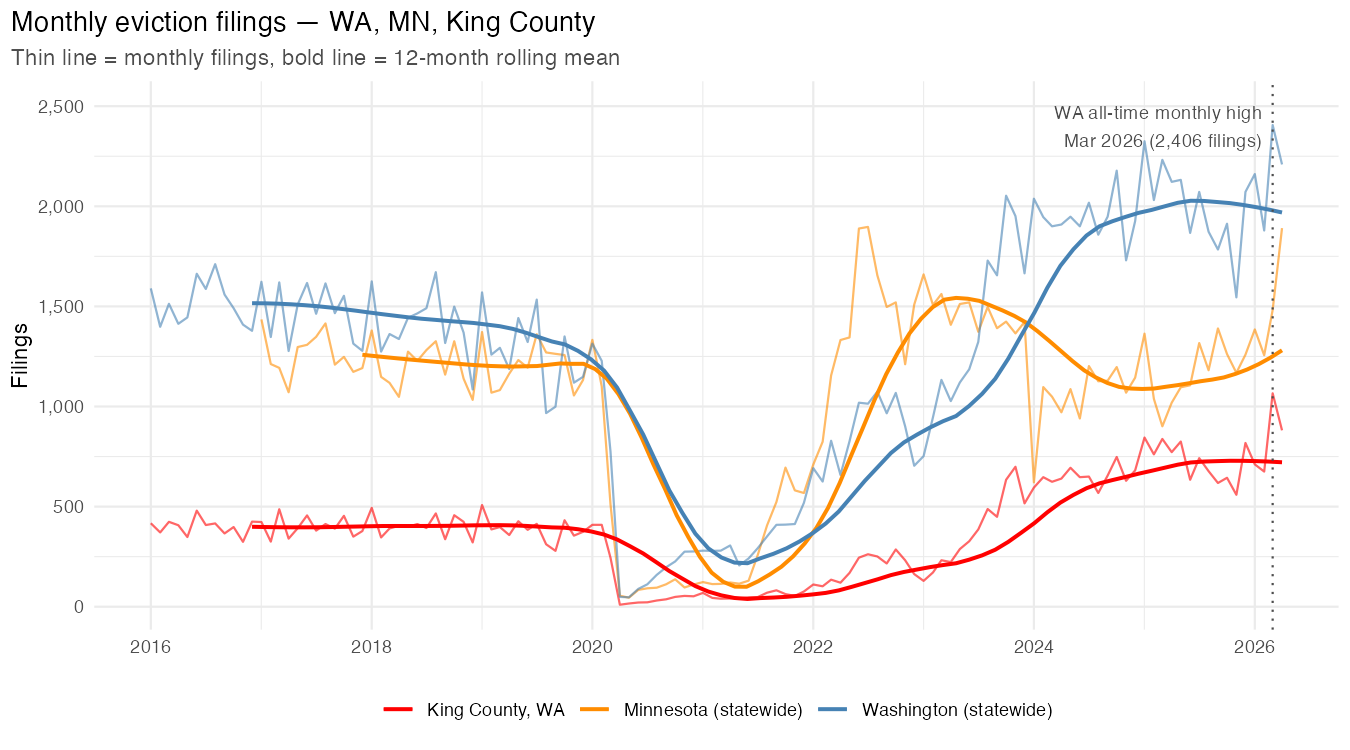
In March 2026, Washington's superior courts recorded 2,406 eviction filings, the highest single month in the series, including 1,066 in King County, also a record. The month matters less than the level it confirms. The trend climbed for three years and settled far above its old range: filings over the year ending April 2026 totaled about 23,913, roughly 44% above pre-pandemic, and they have stayed there. A spike recedes; this has not.
A record month invites two misreadings: as a one-month anomaly, or as a fresh surge. The seasonal decomposition rules out both. With the normal seasonal rhythm removed, March 2026 ranks 11th among the series' largest deviations; the largest, by a wide margin, all came in fall 2023, when filings stepped up to a new level and did not recede. The record is not a new shock. It is confirmation that the fall-2023 step-up held.
Under the hood: how we separate "level" from "shock"
For each month we compute an expected count from the recent trend and the pre-pandemic seasonal pattern, then measure the gap:
The seasonal index comes from 2017–2019 monthly means. March 2026's residual is +361 filings: real, but ranked 11th. The four largest residuals are all fall 2023: October +769, November +762, August +631, September +627. The 12-month total is 23,913 (ending April 2026) vs. 16,649 a year before the pandemic, a rise of +43.6%. (Against calendar 2019 the rise is +57%; we lead with the more conservative 12-month basis.)
Moratoria cut filings to a tenth of normal; in fall 2023 they climbed back through the pre-pandemic baseline and stayed above it.
Monthly filings for Washington, Minnesota, and King County, with 12-month rolling totals. Washington's record months are the top of a multi-year climb, not isolated peaks.
2 · The fall-2023 step-up
Washington's filings did not climb smoothly; they stepped up sharply in fall 2023. Through mid-2023, two things held recorded filings down. The first was federal emergency rental assistance, which paid tenants' back rent. The second was Washington's Eviction Resolution Pilot Program (ERPP), a statewide requirement, from November 2021, that a landlord obtain a Dispute Resolution Center certification before a nonpayment case could be heard. Court data show the program routed a measurable share of cases out of the filing count entirely.
The pilot sunset on July 1, 2023, just as the rental aid ran out. Monthly filings rose from about 1,200 in June to 2,053 in October, the first month above 2,000 in the series. Part of the fall-2023 step-up is therefore not a fresh surge in hardship; it is the removal of a diversion mechanism, with cases the program had routed out of court returning to the docket. This is the single most important annotation on the Washington time series, and it bears on the present: the federal government is now withdrawing supports of its own, the subject of this paper's closing section, and the 2023 sunset is the closest in-state evidence of what withdrawal looks like in the filing data.
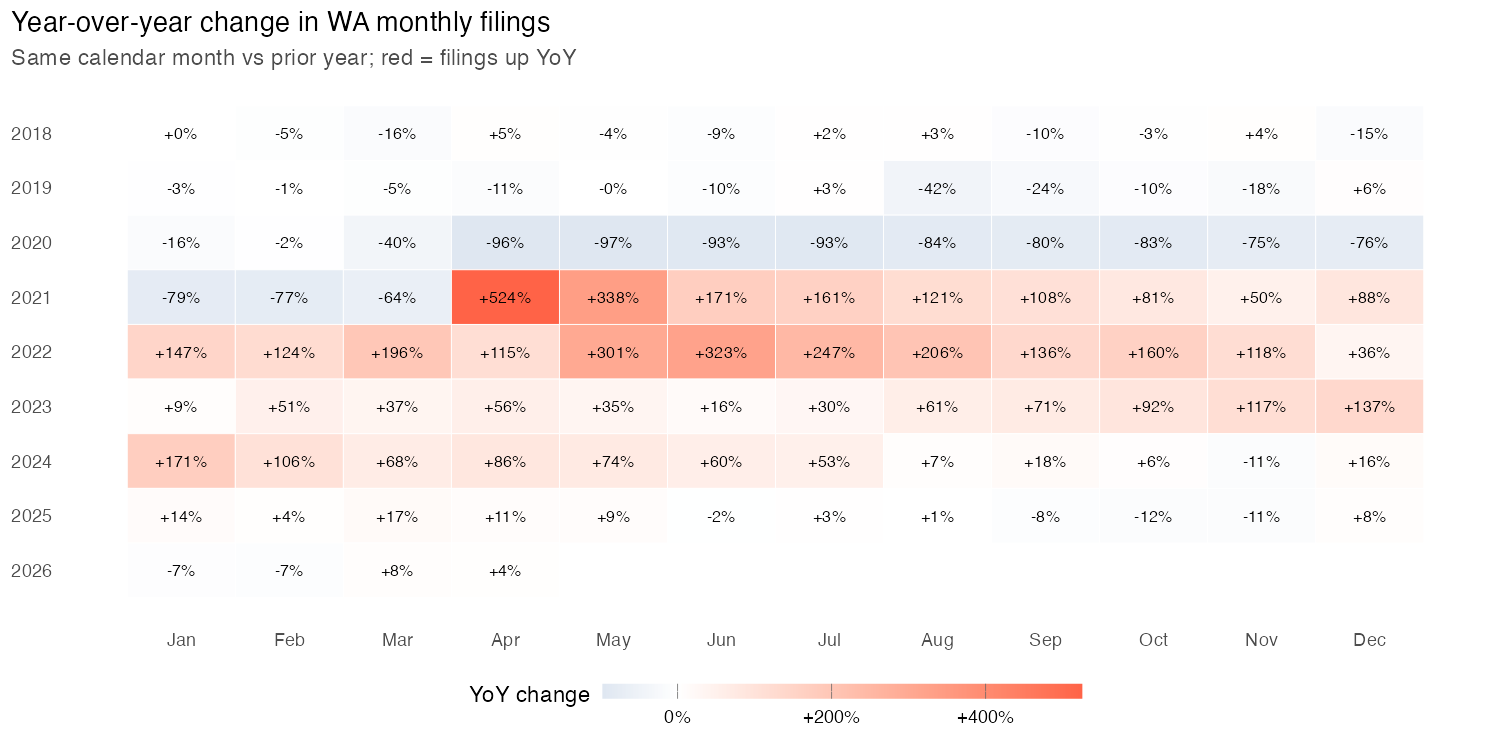
Growth cooled to near zero, because filings had already settled at a record-high level.
Year-over-year percent change, each year by calendar month. The deep-red 2022 row is the post-moratorium backlog; by 2025 the grid cools to near zero. Near-zero growth on top of a record-high level means the level is holding, not easing.
How to read this heatmap
Each square is one month compared with the same month a year earlier: a growth rate, not a count. Rows are years (2018 at the top, 2026 at the bottom); columns are calendar months, January through December.
Color: red means filings rose versus a year before, blue means they fell, and near-white means roughly flat; the deeper the red, the larger the year-over-year jump. The blue band across 2020 is the moratorium collapse, with filings down as much as 97% from the year before.
Mind the base effect. The huge reds of 2021–2022 (for example, +524% in April 2021) are mostly arithmetic: they are measured against the near-zero moratorium months of 2020, so even a modest rise in actual filings reads as an enormous percentage. Treat them as "rebounding off a floor," not "five times worse."
What the figure shows. By 2025 the grid fades to near-white, and that is not the crisis easing. A year-over-year change near zero on top of a record-high level means filings are holding at that high level, not returning toward normal. Here, pale means stuck at the top, not "back to baseline."
3 · The pressure underneath
Behind the policy timing is a slower, structural pressure. Metro Seattle asking rents rose from about $1,464 to $2,091 between 2017 and mid-2025, a 43% nominal increase, roughly twice metro Minneapolis's 21%. That difference between the two metros recurs throughout this analysis.
The federal evaluation of pandemic rental assistance put the point plainly: emergency aid "was neither intended nor equipped to address the nation's pre-existing and continuing housing challenges. As of 2023, a quarter of US renter households were severely rent-burdened, spending half or more of their income on rent." Emergency aid relieved arrears while it lasted; the underlying affordability gap remained.
4 · What predicts where filings are high
To ask which county conditions travel with high filing rates, we assembled a panel of 8,802 county-years across 1,369 counties (Washington and Minnesota court records plus a 29-state national extract, joined to Census demographics and rent), and fit three models that learn in very different ways: a Bayesian machine-learning model (BART), a random forest, and a plain regression (OLS). Using three different methods guards against artifacts of any one of them.
Two features replicate across methods:
Almost everything else is fragile: the models disagree about it, and a fourth check (bootstrapping the importance scores) shows the rankings are within noise. Unemployment, for instance, tops one model's importance list but is statistically insignificant in the regression and ranks 8th in another, a clean example of why a single model's "top predictor" can mislead.
Under the hood: the actual coefficients and fit
Model fit (moderate, by design). Cross-section BART: in-sample R²(log) = 0.55; 10-fold cross-validated R²(log) = 0.38; OLS R² = 0.30; random-forest out-of-bag R² = 0.51. About 60% of county variation in (log) filing rate is unexplained, hence "screening tool, not effect sizes."
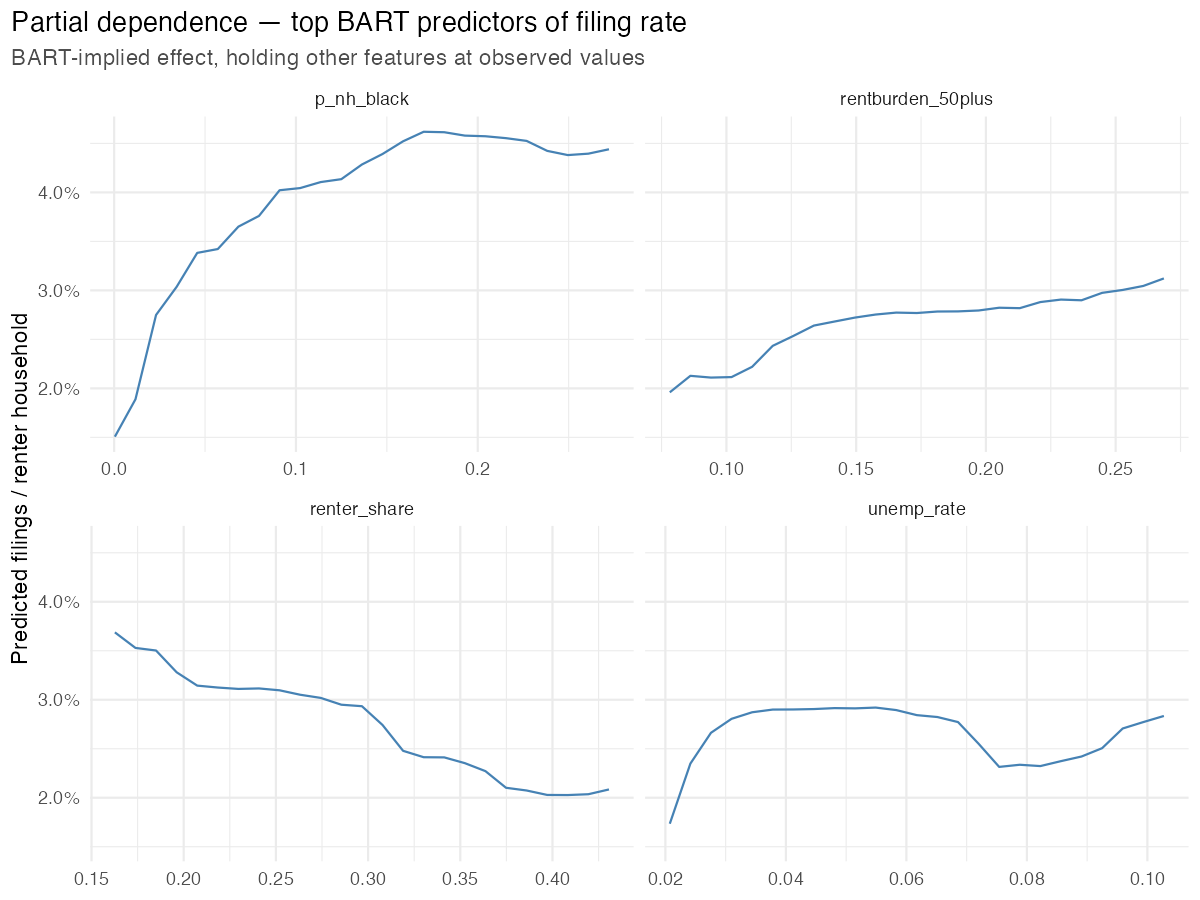
Standardized OLS coefficients (per 1 SD; |t| shown). Non-Hispanic Black share β=+0.44, t=9.8; severe rent burden β=+0.24, t=6.7; median rent +0.22, t=3.0; single-family-rental share −0.22, t=−5.3; renter share −0.16, t=−3.5 (collinear with rent burden). The partial-dependence slope for Black share rises from a predicted ~1.5% to ~4.6% filing rate across its range.
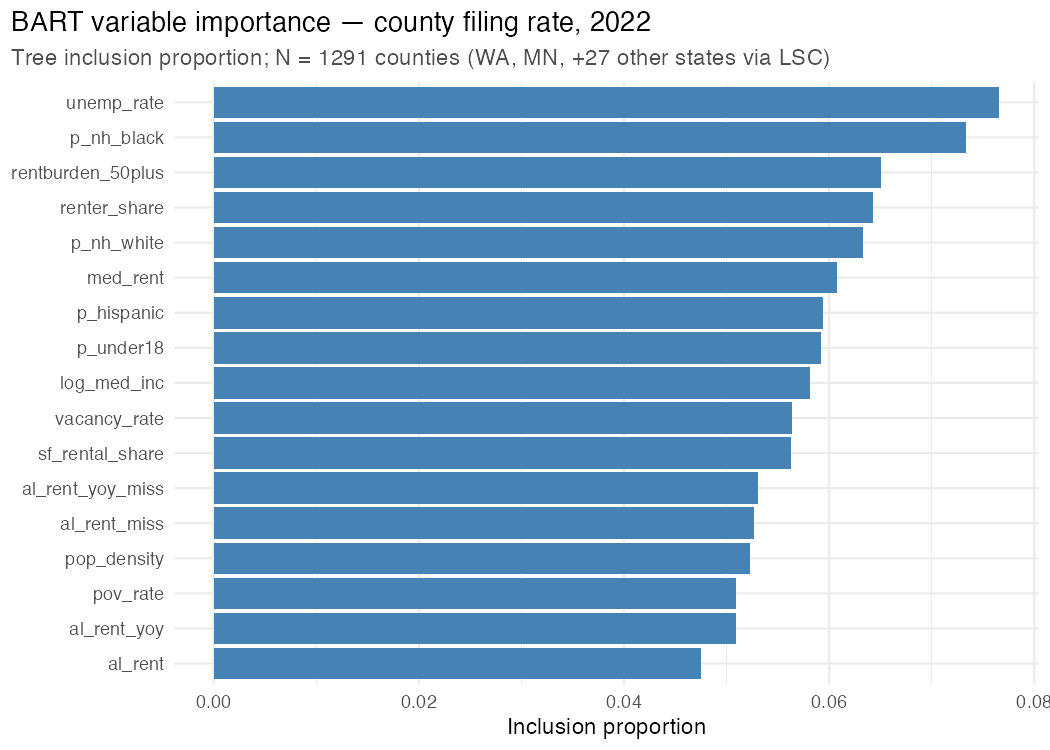
Why the rankings are "noise." BART tree-inclusion is normalized so a meaningless predictor scores 1/17 = 0.059. Across 30 bootstraps, the scores run 0.042–0.076 and no predictor clears two standard deviations above that uniform baseline, so the fine rank order should not be over-read. The robust evidence for the two signals comes from the OLS coefficients and partial-dependence curves, not from the importance ranking. Adding 2020 Democratic vote share gives a real but modest β=−0.13 (t=−2.33), most plausibly a proxy for state/local tenant-protection regimes.
As severe rent burden and Black population share rise, predicted filing rates climb steeply; the other features are flat or unstable.
Partial-dependence curves for the top features: how the predicted filing rate moves as each feature sweeps across its range, holding the others fixed.
The importance scores are nearly flat, which is why we lead with two signals, not a ranking.
BART variable-importance (tree-inclusion) for the cross-section. The bars cluster near the uninformative baseline; the rank order below the top entries is within noise.
5 · The King County question
King County draws the most attention, and it is best compared with the rest of Washington: same courts, same filing law, same data source, followed over time. We deliberately do not benchmark King against other states or a national model: what counts as a "filing," and when it reaches the docket, differs so much between states' legal processes that cross-state filing levels simply are not comparable. Within Washington, the comparison is like-for-like.
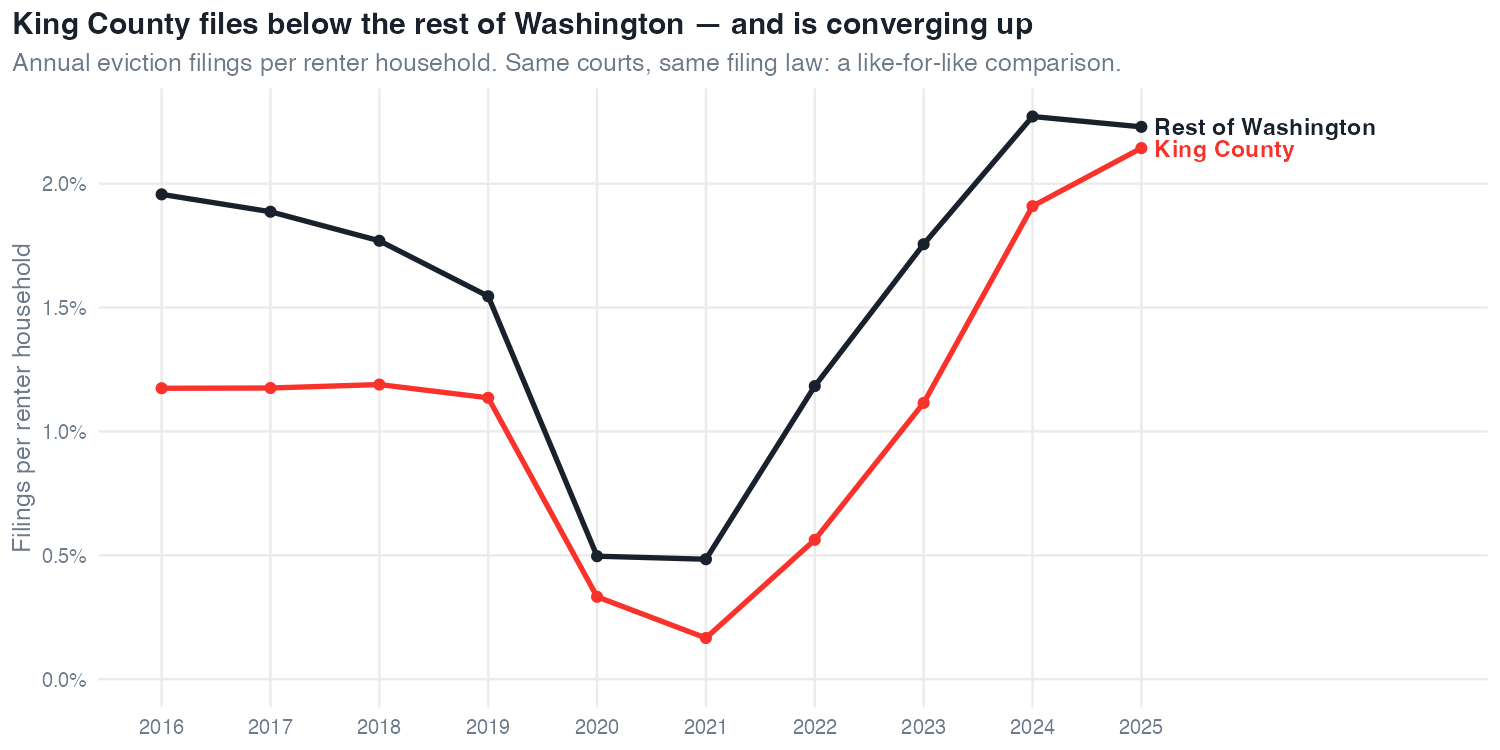
Read that way, King is no anomaly. It has long filed at a lower rate per renter than the rest of the state, about 0.73× the rest-of-Washington rate in 2019, before any of the 2020–21 policies. It bottomed in the 2022 post-moratorium trough (0.48×), then climbed steeply as the pandemic-era programs lapsed: its annual rate rose from 0.56% in 2022 to 1.91% in 2024 and 2.14% in 2025, converging to 0.96× its peers (essentially parity). In March 2026, King recorded 1,066 filings, its own all-time monthly high.
King is not an exception to the statewide trend. It is converging toward it, and what it is converging toward is the record-high plateau documented above.
| Year | King | Rest of WA | King ÷ rest-of-WA |
|---|---|---|---|
| 2019 | 1.14% | 1.55% | 0.73× |
| 2022 | 0.56% | 1.18% | 0.48× (trough) |
| 2024 | 1.91% | 2.27% | 0.84× |
| 2025 | 2.14% | 2.23% | 0.96× |
King has filed below the rest of Washington throughout, and is now converging up toward it.
Annual eviction filings per renter household, King County vs. the rest of Washington. Both fall under the moratoria, then climb sharply from 2022; King closes most of the gap by 2025.
6 · Is Washington different?
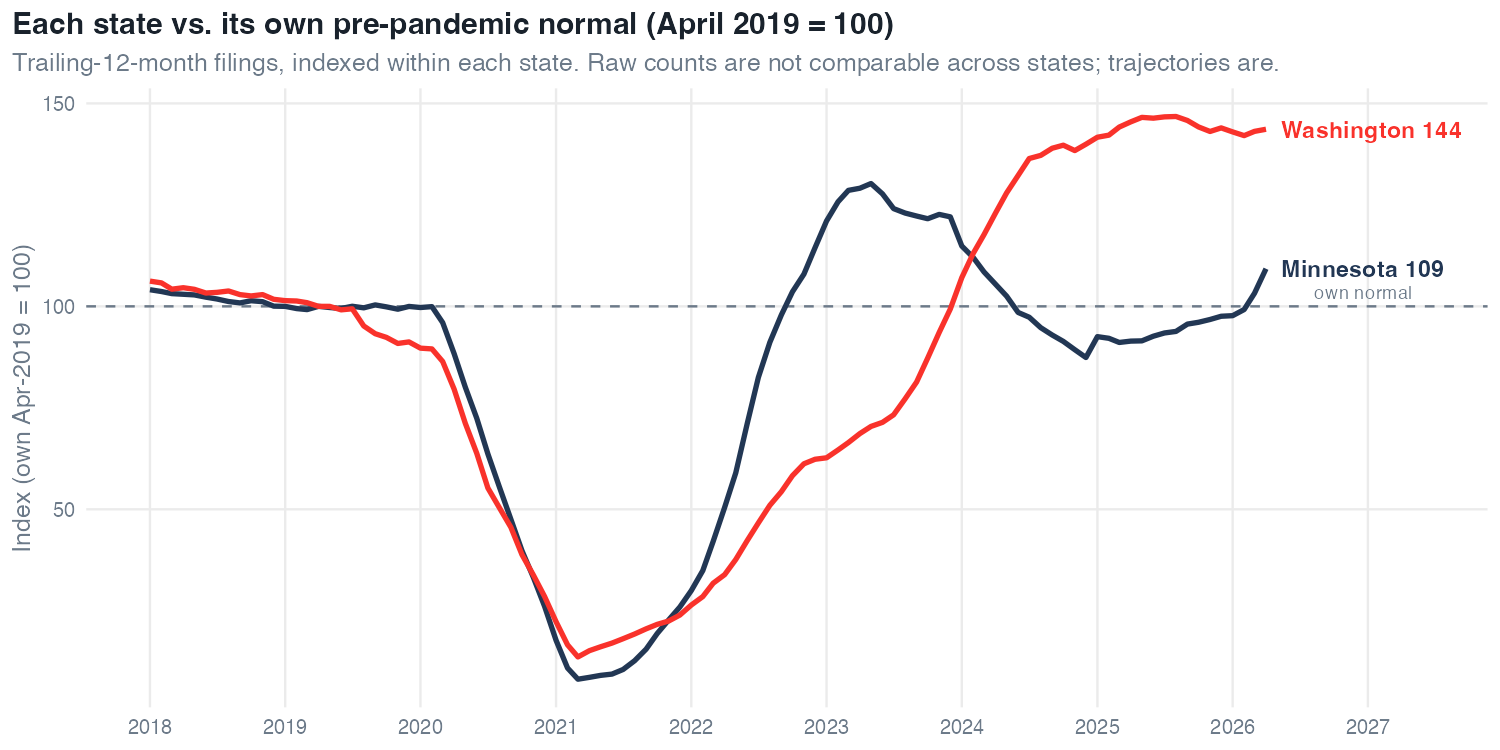
Raw filing counts are not comparable across states, so the comparison indexes each state to its own pre-pandemic normal (April 2019 = 100). On that footing the gap is clear: by April 2026 Washington sits about 44% above its own normal (index 144); Minnesota only about 9% above its own (index 109). Minnesota actually dropped below its normal in 2024 before recovering. Washington's rise is real and outsized, not an artifact of how the two states count.
That divergence is not a clean test of policy: the two states differ in rent trajectories, court rules, industry mix, migration, and recent legislation. Several of those differences plausibly drive the split:
The divergence is real but multi-causal; it does not isolate a single "Washington factor."
Indexed to each state's own normal, Washington has pulled far above it; Minnesota has not.
Trailing-12-month filings, each state indexed to its own April-2019 level (= 100). Indexing removes the cross-state level problem: we compare each state with its own pre-pandemic baseline, not with the other's raw counts.
7 · What the national rental-assistance study teaches
The UC Berkeley / UPenn evaluation of federal Emergency Rental Assistance (HUD-approved, February 2026) provides the strongest causal evidence in this area. Washington was not in its estimation samples; the relevance comes from where the effects concentrated.
For Washington the evidence gap remains: no estimate covers the state specifically. Closing it is the priority study named at the end of this paper.
Under the hood: the dose-response estimate
Tract-level, the adjusted model gives an ERA-dollar coefficient of −3.98 filings per 1,000 renters per one-unit log increase in dollars (the unadjusted estimate is −6.903). In the county model, log ERA dollars, % Black, % Asian, % unemployed, and % rent-burdened are all significant negative predictors of filings; days of moratorium carry a positive but statistically insignificant sign once dollars are controlled. Implied cost-effectiveness is roughly $7,750 per assisted household.
8 · What works
Prevention is the better-documented half of this subject. An eviction filing is an early step on the path from a missed rent payment toward losing a home and, for those who fall furthest, toward homelessness. No single policy stops that path; the evidence points to a short list of levers, each acting at a different stage, grouped here in three families. The tiers below rank documented effect size and speed, not standalone sufficiency. Washington has adopted the strongest of these tools; what it has not done is run them at full scale at the same time.
The levers grouped by Protect · Preserve · Produce, placed along the path from missed rent to lost home.
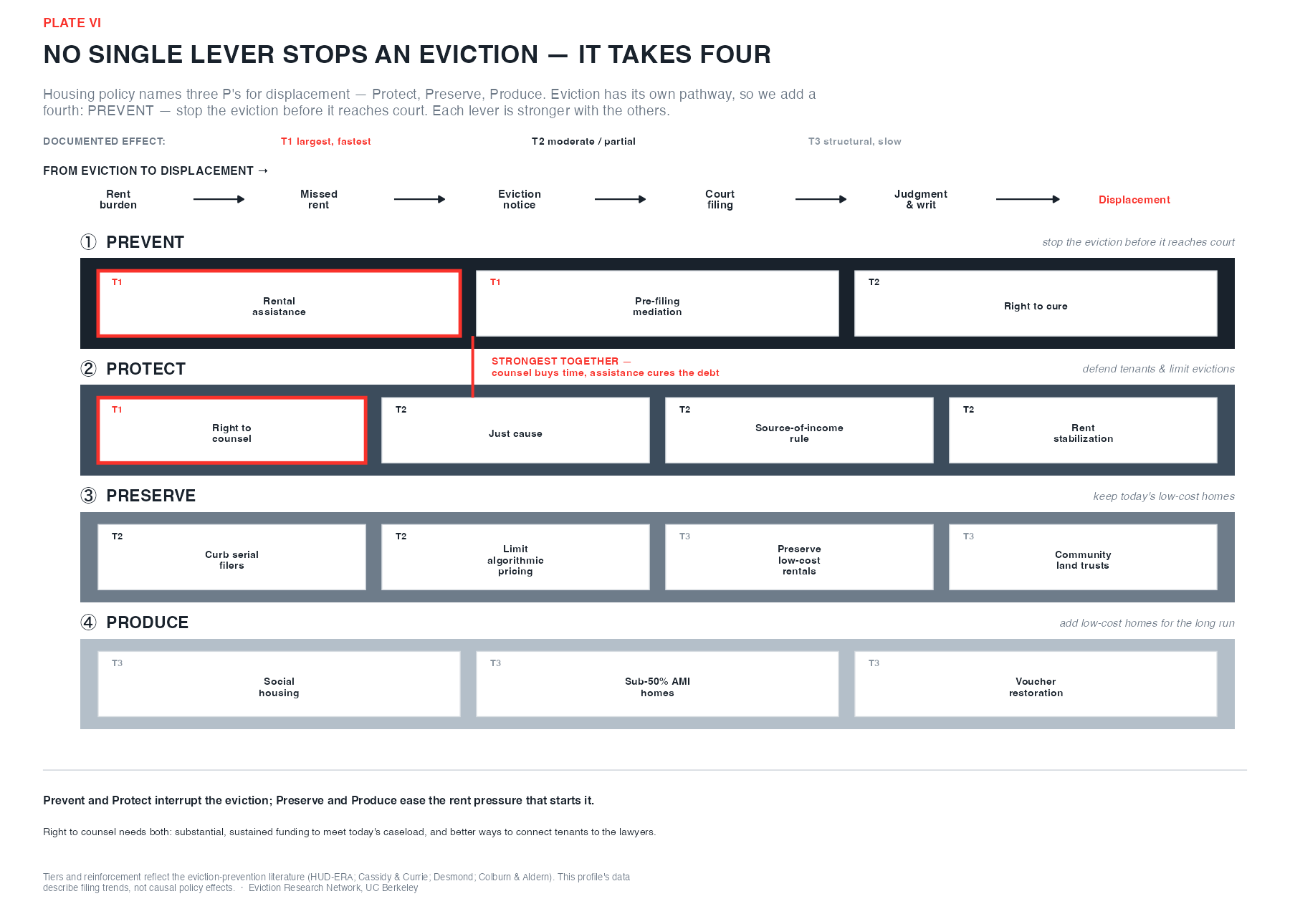
① Protect renters facing eviction now. The documented effects here are the largest.
② Preserve the homes that exist.
③ Produce new low-cost supply, the slowest and most durable lever.
The cost-benefit literature for these levers is real but fragile: most estimates are transported from New York, LA, or Philadelphia, and many double-count avoided shelter costs. Treat any single ROI with at least ±50% uncertainty.
| Lever | Cost | Documented effect | Likely net-positive where |
|---|---|---|---|
| Right to counsel | ~$23K per case (NYC; ~$8.8K per represented person) | −62% possessory judgments (NYC); better outcomes in WA | high-shelter-cost cities (Seattle qualifies) |
| Pre-filing mediation | per-case cost not well established | ~75% reach agreement (Phila); WA ERPP 78% settled | strong court + nonprofit partnership |
| Rental assistance | $6K–$10K per household | 35–53% fewer moves; 60–65% less street homelessness | crisis periods; large downstream value |
| Just cause | $0 fiscal | small on no-cause; ~0 on nonpayment | already in WA |
9 · What we still don't know
Rental assistance carries the largest documented prevention effect in the literature, yet no estimate of that effect exists for Washington. The federal program has ended, but measuring what it did here is retrospective work, and the records for it survive: how much assistance went to each county, and when, during 2021–2023; the county-by-month filing series used in this paper; and Census counts of renter households. Linking those in a dose-response study of dollars against filings is the highest-value analysis available, and it would tell the legislature what any state-funded successor program could be expected to buy. A close second is a formal evaluation of Washington's own right-to-counsel and mediation programs against filing volumes and outcomes; those records sit with the Office of Civil Legal Aid and the Administrative Office of the Courts.
Everything in this paper is a screening result and a literature synthesis. Washington is unusually well positioned to close both gaps.
Appendix A · Methods & data
Court records (the outcome). Washington and Minnesota county-month unlawful-detainer (UD) filing counts, 2016–2026, with renter-household denominators from the American Community Survey. A national extract (Legal Services Corporation counties, through May 2023) adds 1,243 more counties for the cross-section; Washington is not in that national source, and Minnesota's rows in it are dropped to avoid double-counting with its court panel.
Joined predictors. ACS 5-year demographics and housing (renter share, median rent, income, poverty, race/ethnicity shares, child share, rental vacancy, severe rent burden, single-family-rental share, population density), Apartment List county rent, and 2020 county presidential returns. Renter denominators are ACS-based throughout, so cross-source rate comparisons are not biased by the denominator, only by how each source defines a "filing."
The modeling panel. 8,802 county-year observations, 1,369 counties, 2016–2025. The headline cross-section is 2022 (N = 1,291 counties, 29 states); a change model uses 126 Washington + Minnesota counties (2018–19 to 2024).
BART (Bayesian Additive Regression Trees, dbarts): outcome log(filings_per_renter + 1e-4); 4 chains × 2,000 draws × 200 trees; importance via tree-inclusion, normalized to a uniform baseline of 1/17 = 0.059. Random forest (ranger, 1,000 trees, permutation importance). OLS with z-scored predictors. Fit, bootstrap importance (30 resamples), and the King benchmark come from a strengthening re-analysis.
Seasonal decomposition for the monthly question: seasonal index from 2017–2019 means; expected = (trailing-12 ÷ 12) × seasonal_index; residual = filings − expected. Crude but adequate for ranking monthly surprises.
Appendix B · Glossary
Appendix C · Sources & citations
This white paper is an exploratory analysis of county-level patterns and a synthesis of the eviction-prevention literature. It describes correlations and policy context, not proven causes. Questions: evictions@berkeley.edu. Back to top · Washington eviction profile.