How Much ERA Reduced Evictions
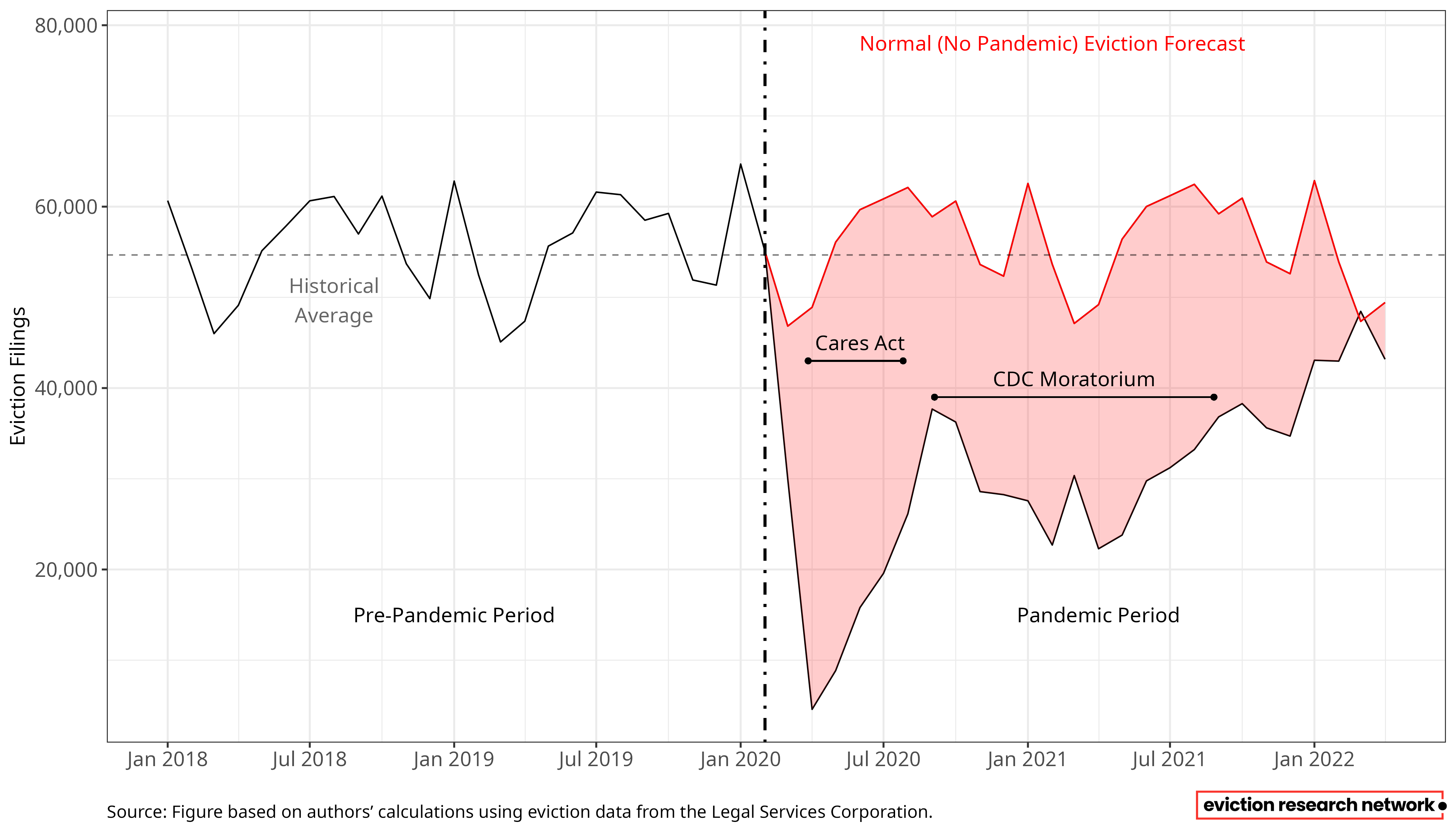
Across the counties in this study, actual eviction filings between March 2020 and early 2022 ran approximately 45% below what pre-pandemic trends would have predicted — roughly 673,000 fewer filings. That gap reflects the combined force of federal moratoriums, state-level protections, and Emergency Rental Assistance. Disentangling how much each contributed is the work of the statistical models in this report.
The research team analyzed filings across more than 700 counties, comparing the two years before the pandemic (March 2018–February 2020) to the two years during it (March 2020–February 2022). Counties that received more ERA were compared to those that received less, controlling for differences in demographics, housing markets, and state laws. A separate analysis zoomed in to nearly 12,000 neighborhoods across 10 states. Both levels of analysis told the same story — more ERA meant fewer evictions, regardless of which statistical method was used.
The effects were not spread evenly. ERA did the most good in the places with the greatest need. Among counties that received the most ERA funding (the top 10%), those with the highest shares of low-income renters saw nearly 75 fewer eviction filings per 1,000 residents compared to pre-pandemic levels. At the neighborhood level, more ERA dollars consistently translated into fewer filings, especially in communities with high unemployment and heavy rent burdens.
Eviction filings in the study counties ran 45% below pre-pandemic forecasts — roughly 673,000 fewer filings — reflecting the combined impact of moratoriums and rental assistance.
The program worked. But did it reach those who needed it most?
Who Got the Money, and Why It Matters
Congress distributed ERA based on population size, not on how many people in a community were at risk of eviction. A large county with low poverty and a large county with high poverty received similar amounts. The money went where people lived, not where the housing crisis was worst.
That matters for two reasons. First, it means these findings are on stronger footing. When the government sends more money to places with more problems, it's hard to know whether improvements came from the money or from other things those places were already doing. Because ERA was spread by population — almost like flipping a coin — researchers could more confidently measure what the money itself accomplished.
Second, it reveals what happened when local administrators decided how to spend the funds they received. The Berkeley team tracked where ERA dollars actually landed, neighborhood by neighborhood. Within their jurisdictions, program staff generally directed funds toward the communities with the greatest need — more eviction risk, more unemployment, higher shares of Black and Asian residents, heavier rent burdens.
But that local targeting had a limit. The neighborhoods facing the very highest eviction risk — the top quarter — did not receive proportionally more than neighborhoods just below them. The most desperate communities hit a funding ceiling. When the starting pot of money is set by population count rather than need, local administrators can only do so much to redirect it. Future programs should build need-based formulas into the federal allocation itself, not leave it entirely to local discretion.
ERA's effectiveness also varied by race. Counties with higher shares of Black residents saw stronger eviction-prevention effects. Black renters face higher eviction risk at every income level — a well-documented pattern driven by decades of housing discrimination, wage gaps, and unequal access to credit. ERA mattered more in these communities precisely because the need was greater.
State policy environments mattered, too. ERA had its largest effects in states with the fewest existing tenant protections — places with short eviction timelines, no right to counsel, and few limits on landlord filings. In those states, renters had almost no safety net before ERA arrived. The program filled gaps that other policies left open, which means rental assistance is most critical precisely where tenants have the least legal protection.
Less Red Tape, Better Outcomes
One of the study's clearest policy lessons is about paperwork. Some ERA programs took a shortcut. Instead of requiring tenants to produce pay stubs, lease agreements, and notarized documentation of hardship, they checked eligibility against publicly available data — census records, area median incomes, neighborhood poverty rates. If the data already showed a household was likely eligible, the program didn't make the tenant prove it again.
These low-paperwork programs prevented more evictions, especially where funding was high. The families least likely to navigate a complex application — people who just lost their jobs, are juggling children, or don't speak English fluently — are often the same families closest to being evicted. Removing barriers meant reaching them before it was too late.
Court timelines mattered too. States where the eviction process took longer — giving tenants more time to apply for and receive assistance before a judge ordered them out — reported fewer filings during the pandemic. Legal timelines and rental assistance worked better together than either did alone.
What the Household Studies Found
The county and neighborhood analyses show ERA's impact in aggregate. But what happened to individual families? The Penn team — led by the Housing Initiative at Penn (HIP) — surveyed households in Los Angeles and Philadelphia one to two years after they applied for help. (For the full household-level analysis, see HIP's ERA project page.)
In Los Angeles, families who received ERA were 53% less likely to have moved and 65% less likely to end up on the street. In Philadelphia, ERA reduced the odds of moving by 35% and the odds of homelessness by 60%. Families with children — nearly half of all applicants in both cities — were disproportionately protected.
ERA didn't just help tenants; it changed landlord behavior. In Philadelphia, landlords who did not receive ERA filed for eviction at four times the rate of landlords who did in the six months after funds were disbursed. Philadelphia's innovation was to pair ERA with an eviction diversion program that required landlords to apply for assistance and wait 45 days before filing in court — turning rental assistance into a direct eviction prevention tool.
Landlords who did not receive ERA filed for eviction at 4× the rate of landlords who did — in the six months following ERA disbursement.
The household data also exposed a critical barrier — landlord participation. In both cities, applications where the landlord was unresponsive were far less likely to be approved. In Philadelphia, landlord-initiated applications were 30 percentage points more likely to succeed. Without landlord engagement, tenants were more likely to be displaced informally. Among unfunded applicants who moved, a third reported their landlord forced them out with no court proceeding, compared to about 18% among funded applicants.
One-third of payments in Los Angeles went directly to tenants rather than landlords, a design choice that helped reach the most vulnerable — Hispanic and Latino applicants, Spanish speakers, and people in less formal housing like converted garages — whose landlords were least likely to participate.
The Broader Picture
This study is one of several recent efforts to measure what pandemic-era housing interventions accomplished. Princeton's Eviction Lab found that COVID-era policies cut eviction filings by more than half. Federal Reserve researchers confirmed that ERA funds reached the highest-risk communities. And an NBER study of five cities found that ERA increased rent payment and reduced eviction concerns, though temporary assistance could not substitute for structural affordability. (The U.S. Treasury documents the full scope of ERA distributions.)
The evidence converges: ERA worked, but it had its limits. Those limits were real. Pandemic-era protections are gone. Eviction filings have returned to or exceeded pre-pandemic levels in many cities. More than 80% of ERA-eligible renters remained rent-burdened in 2023, according to the Center on Budget and Policy Priorities. A temporary program cannot solve the underlying shortage of housing affordable to people at the bottom of the income distribution.
What $46.6 billion did accomplish was to prove that cash, delivered to the right people through well-designed programs, prevents the most immediate and damaging consequence of that shortage — families removed from their homes. The county and neighborhood data in this study show the mechanism in detail. The Los Angeles and Philadelphia case studies put faces behind the numbers. Together, they make a strong case for permanent rental assistance as a first-line response to housing instability — not an emergency measure deployed only after the next crisis arrives.